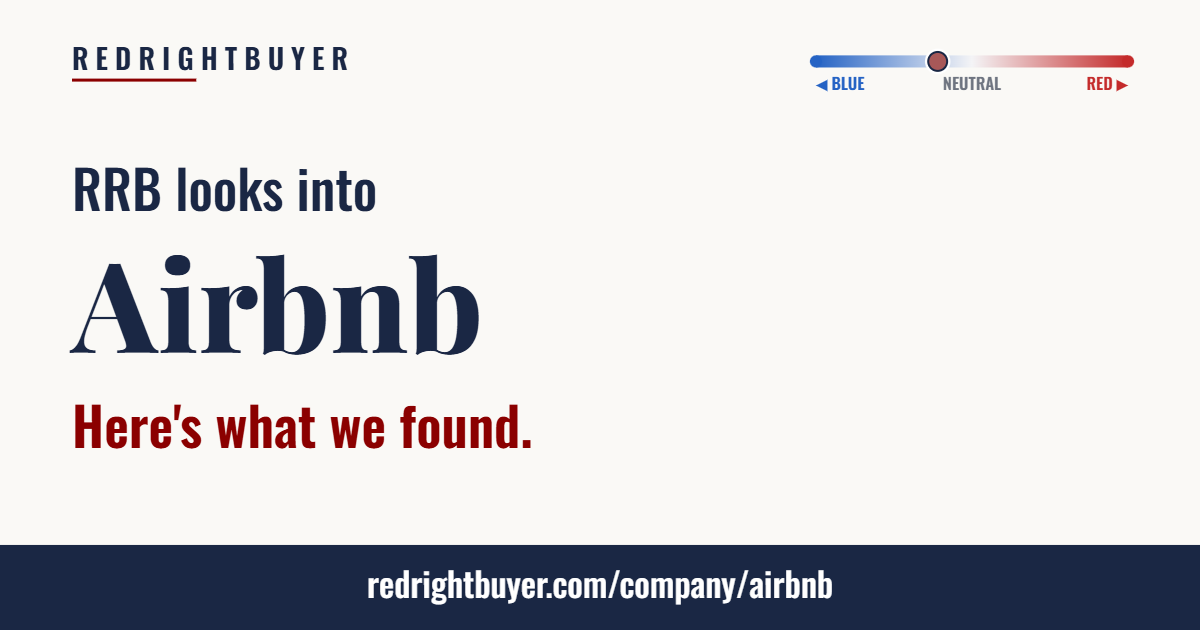

Airbnb became one of the world's largest online marketplaces for short-term lodging. Founded in San Francisco in 2008 by three young designers and engineers who rented out air mattresses in their apartment to make rent, the company grew into a publicly traded marketplace that now lists stays from more than five million hosts and has handled billions of guest arrivals.[1] Along the way it became something hotels never had to be: a company whose entire business depends on persuading thousands of city councils, state legislatures, and federal agencies not to regulate it out of existence. That reality shapes Airbnb's politics more than any party loyalty does. But the company also has a history of taking loud public stands on hot-button cultural issues, and its founders have political stories of their own, including one that has pulled sharply to the right.
- Airbnb gives little to candidates but spends heavily lobbying to shape short-term rental laws.
- Its 2017 Super Bowl ad was a direct shot at President Trump's travel ban.
- After January 6, Airbnb cut off PAC money to lawmakers who voted against certification.
- A co-founder went from Democratic donor to a top official in the Trump administration.
- Its political fights often pit the platform against hotel worker unions, not a party.
A Small Corporate PAC With a Cautious Footprint
Airbnb is a relative newcomer to organized political giving. The Airbnb Inc. PAC, registered with the Federal Election Commission, is a modest operation compared with the war chests of older corporations. In the 2023-2024 cycle the PAC gave $32,000 directly to federal candidates, a small sum for a company of Airbnb's size and visibility.[2]
That money tilted modestly Democratic: $19,200 (60 percent) went to Democrats and $12,800 (40 percent) went to Republicans.[2] The recipient list, though, reads less like an ideological roster than a map of lawmakers who sit on committees that matter to a platform business. The single largest recipient was Representative Darren Soto, a Florida Democrat, at $3,300, followed by a mix of Republicans such as Andrew Garbarino, Bob Latta, Young Kim, and Brett Guthrie and Democrats such as Nanette Barragan, Sylvia Garcia, and Josh Gottheimer.[2] The pattern is consistent with a company spreading modest checks across members useful to its regulatory agenda rather than backing one party.
The most telling moment in the PAC's short history came in January 2021. Days after the January 6 attack on the U.S. Capitol, Airbnb announced that its PAC would withhold support from any member of Congress who had voted against certifying the 2020 presidential election results, and the company condemned the attack in unusually direct terms.[3] That decision placed Airbnb among the more aggressive corporate responses after January 6, a posture that read as more aligned with Democratic framing of those events than Republican.
Lobbying Is Where the Real Money Goes
For Airbnb, campaign contributions are a sideshow. Lobbying is the main event. The company has spent at or near record levels on federal lobbying in recent years, repeatedly reporting annual federal lobbying around or above $1 million, and more still when state-level lobbying is added in.[4] It also lobbies heavily at the state level in markets where short-term rental rules are contested, spending across multiple states in a given year.[5]
The target of nearly all this spending is the same: rules governing short-term rentals. Cities and states across the country have moved to tax, cap, register, or in some cases effectively ban short-term rentals, citing housing affordability and the impact on traditional hotels. Airbnb has fought these measures aggressively, opposing rental registries and pushing for lighter regulatory frameworks.[6] In early 2025 the company escalated, launching a multimillion-dollar Super PAC aimed at New York City elections to back candidates friendlier to short-term rentals after the city imposed what Airbnb called a de facto ban.[7] None of this is partisan in the traditional sense. Airbnb backs whoever will protect its platform, Democrat or Republican, and its lobbying touches bills sponsored by members of both parties, including pricing-transparency legislation carried by lawmakers on each side.[5] The fight is often better understood as platform versus organized labor than as left versus right: Airbnb has publicly criticized the powerful Hotel and Gaming Trades Council, the hospitality workers union, over the short-term rental restrictions it opposes, and that union tends to fund the same progressive Democrats Airbnb's money works against. It is a business-interest battle that scrambles the usual partisan map.
A Corporate Brand That Has Worn Its Values Loudly
Where Airbnb has drawn the clearest political lines is in its public branding, and historically those lines have leaned progressive. The most famous example came during Super Bowl LI in February 2017, when Airbnb ran its "#WeAccept" ad, a montage of diverse faces with a message of inclusion produced as a direct response to President Trump's travel ban affecting several majority-Muslim countries.[8] Alongside the ad the company pledged free short-term housing for 100,000 people in need and a $4 million donation to the International Rescue Committee.[9] Airbnb also joined other technology firms in opposing the travel ban in court.
These moves, together with the company's prominent non-discrimination policies and its Airbnb.org disaster- and refugee-housing arm, built a corporate identity that critics on the right have at times labeled politically progressive. The company frames them instead as expressions of its founding idea that anyone should belong anywhere. Either way, the public posture has historically tilted culturally left, even as the company's checkbook politics remained transactional.
The Founders Diverge
Airbnb was built by three co-founders, and their personal politics have not moved in lockstep. CEO Brian Chesky, the public face of the company, has historically been associated with Democratic-aligned causes and is a signatory to the Giving Pledge, committing the proceeds of his equity to charity.[10] Co-founder and chief technology officer Nathan Blecharczyk has kept a comparatively low political profile.
The sharpest turn belongs to co-founder Joe Gebbia. A former Democrat, Gebbia publicly shifted rightward, saying he voted Republican in the 2024 presidential election, voicing support for Robert F. Kennedy Jr., and backing conservative candidates with substantial personal checks, including a reported $1 million to Texas Governor Greg Abbott's 2025 campaign and, from his own personal funds rather than the company's, a total of $3 million split across three super PACs supporting Andrew Cuomo and opposing progressive Zohran Mamdani in the 2025 New York City mayoral race. Airbnb publicly stressed that these were Gebbia's personal donations, not the company's. He joined the Trump administration's Department of Government Efficiency, the cost-cutting initiative associated with Elon Musk, in early 2025, and in August 2025 was appointed the federal government's first Chief Design Officer, leading a newly created National Design Studio tasked with modernizing government websites and services.[11] Gebbia, who also sits on the board of Musk's Tesla, drew protest from some Airbnb hosts who removed their listings over his government role, though by then he had stepped away from day-to-day company operations.[12] His evolution, from Democratic donor to a named official in a Republican administration, is a striking illustration of how a founder's personal politics can diverge from the company that still carries his fingerprints, and it cuts against the progressive image the brand cultivated in the 2010s.
Keeping the Threads Separate
Airbnb presents an unusually layered political picture. The corporation itself behaves like what it is: a platform business whose overriding political goal is favorable regulation, pursued through heavy bipartisan lobbying rather than partisan candidate giving. Its small PAC and its post-January-6 stance lean modestly left of the corporate average. Its branding history leans further left still, anchored by the 2017 travel-ban response. Yet one of its three founders has become a visible figure in a Republican administration. These threads point in different directions, and the honest read is that they should be weighed separately: the company's regulatory self-interest, its culturally progressive corporate voice, and the individual political journeys of the people who built it are three different stories sharing one famous name.
[1] Airbnb company history and scale, Airbnb Newsroom and Airbnb Inc. investor disclosures; founders Brian Chesky, Joe Gebbia, and Nathan Blecharczyk. [2] Airbnb Inc. PAC, FEC committee ID C00731000; 2023-2024 cycle, $32,000 total to federal candidates ($19,200 / 60% to Democrats, $12,800 / 40% to Republicans), candidate recipients and party split per OpenSecrets. [3] Airbnb's January 11, 2021 announcement that its PAC would withhold support from members of Congress who voted against certifying the 2020 election results, as reported contemporaneously by Reuters, CNBC, and other outlets (original Airbnb Newsroom post since archived). [4] Airbnb federal lobbying totals, OpenSecrets organization lobbying profile (annual federal lobbying repeatedly around or above $1 million in recent years). [5] Airbnb state-level lobbying on short-term rental regulation, OpenSecrets and contemporaneous reporting; pricing-transparency legislation sponsored by members of both parties. [6] Airbnb opposition to short-term rental registries and regulation, OpenSecrets News, December 2023. [7] Airbnb-backed Super PAC for New York City elections, 2025 (response to NYC short-term rental restrictions). [8] Airbnb "#WeAccept" Super Bowl LI advertisement, February 2017, produced in response to the Trump administration travel ban. [9] Airbnb pledge of housing relief for 100,000 people and $4 million to the International Rescue Committee, 2017. [10] Brian Chesky biography and Giving Pledge commitment. [11] Joe Gebbia's political shift and government role: Reuters, "New Trump design chief aims to improve thousands of US government websites," Aug. 23, 2025 (DOGE role and appointment as first U.S. Chief Design Officer leading the National Design Studio); Bloomberg and Business Insider reporting on his $3 million in personal donations across three pro-Cuomo, anti-Mamdani super PACs (Fix the City, Defend NYC, Put NYC First) in the 2025 NYC mayoral race, which Airbnb stated were personal and not the company's; additional reporting on his $1 million gift to Greg Abbott's 2025 campaign, his stated 2024 Republican vote, and support for RFK Jr. The Hotel and Gaming Trades Council is named in Airbnb's own public statements on NYC short-term rental rules. [12] Airbnb host protests over Joe Gebbia's DOGE role, San Francisco Standard and related coverage, February 2025; Airbnb trades on the Nasdaq under ticker ABNB (SEC EDGAR CIK 0001559720).
Comments
(0)No comments yet. Be the first to comment.