
Walk into almost any American city and you will find a Hilton. The McLean, Virginia company runs more than 8,000 hotels under brands ranging from the budget-friendly Hampton and Tru to the luxury Waldorf Astoria and Conrad lines, spread across more than 140 countries.[1] For a company that touches roughly a quarter of a billion guests a year, the political question is not whether Hilton spends money in Washington. It is which direction that money points. The answer turns out to be unusually balanced for a company its size, and the more interesting story sits in the gap between the corporation's careful neutrality and the louder political histories of the family whose name is on the door.
One structural fact helps explain the restraint. Most people assume Hilton owns its hotels, but it does not. Hilton runs an "asset-light" business: the vast majority of its properties are franchised to or managed for independent owners, and the company earns its money primarily from franchise and management fees rather than from operating real estate.[17] Because the local zoning, labor, and tax fights that consume an owner-operator largely fall on those independent franchisees, the corporate parent has less direct exposure to political brawls, and a correspondingly lighter political footprint of its own.
- Hilton's PAC split its 2024 federal candidate money almost down the middle between the two parties.
- Most people assume Hilton owns its hotels, but it franchises or manages the vast majority of them.
- CEO Christopher Nassetta opposed North Carolina's 2016 bathroom bill and defended workplace diversity as a business imperative in 2025.
- Founder Conrad Hilton was a Republican New Mexico legislator before building the first international hotel chain.
- Hilton spent roughly $1.05 million on federal lobbying in 2024, focused on hotel-industry issues.
A Corporate PAC That Splits Its Money Down the Middle
Federal law bars corporations from giving directly to candidates, so like most large employers Hilton routes its political giving through a federal political action committee funded by voluntary employee contributions. The Hilton Worldwide Political Action Committee, registered with the Federal Election Commission in 1987, is the company's official channel for federal candidate money.[2]
In the 2023-2024 election cycle, the Hilton PAC gave $51,000 directly to federal candidate campaigns, a figure that counts money to candidates themselves and not the PAC's separate giving to party committees or other PACs. That candidate money split almost evenly: $27,000 (about 53 percent) went to Democrats and $24,000 (about 47 percent) went to Republicans.[3] That is close to a coin flip, and it is the single clearest signal of how the corporation positions itself: as a hospitality business that wants working relationships on both sides of the aisle rather than a partisan actor.
The even headline number hides a more textured pattern underneath. Hilton's PAC tilted Democratic among House candidates, where Democrats took roughly 71 percent of its House dollars, and tilted Republican among Senate candidates, where Republicans took about 59 percent.[3] The recipient list reads like a map of committees that matter to the travel industry rather than an ideological roster: Then-House Speaker Kevin McCarthy, a Republican who was ousted from the speakership in October 2023 and left Congress that December, was the single largest recipient at $5,000, while Nevada Democrats Dina Titus and Steven Horsford, who represent the hotel-heavy Las Vegas region, also drew sizable checks.[3] Senate recipients included Republicans Dan Sullivan and John Barrasso alongside Democrats Tim Kaine, Jacky Rosen, and Bob Casey.[3]
How Hilton Describes Its Own Political Spending
Hilton publishes a U.S. Political Contributions and Disclosure Policy that spells out how these decisions get made. The document states that all federal contributions flow only through the Hilton PAC, are reviewed and approved in advance by the company's Global Head of Public Affairs and ESG, and are made "to promote the interests and business objectives of Hilton, without regard for the private political preference of its executives."[4]
The policy lists the factors that decide who gets money: whether a candidate sits on a committee with jurisdiction over legislation affecting the hospitality and travel industry, the candidate's voting record on issues of direct concern to the company, and whether the candidate represents a district or state where Hilton has significant operations.[4] In plain terms, Hilton says it gives based on what helps hotels, not on party. The roughly even partisan split in the actual FEC data is consistent with that stated approach. The company also notes it does not currently engage in independent expenditures or electioneering communications, the more aggressive forms of corporate political spending.[4]
The Lobbying Footprint
Direct candidate giving is the small part of Hilton's Washington presence. The larger number is lobbying. In 2024, Hilton reported roughly $1.05 million in federal lobbying spending.[5] That is a routine figure for a company of its scale in an industry, lodging and tourism, that collectively spent more than $17 million lobbying that year.[6] Hotel-industry lobbying typically concentrates on issues like labor rules, travel and immigration policy, online booking and short-term rental competition, taxes, and tourism promotion, areas where the business case crosses party lines. Lobbying is a measure of engagement with government, not a partisan signal in itself, but it confirms that Hilton is an active and well-resourced participant in federal policy.
The Trade-Group Channel
A large share of the hotel industry's political influence does not run through any single company at all. It runs through the American Hotel and Lodging Association, the dominant trade group that represents the major chains, roughly 80 percent of franchised hotels, and the largest U.S. hotel companies.[15] As one of the industry's biggest players, Hilton operates within the policy environment AHLA shapes. The association runs its own bipartisan political action committee, HotelPAC, and lobbies on a consistent set of business-interest priorities: expanding the H-2B and J-1 guest-worker visa programs to address labor shortages, opposing stricter "joint employer" and overtime rules, fighting hidden-fee disclosure mandates, and restoring federal tourism-promotion funding.[16] These are pocketbook issues for hotel operators rather than partisan causes, and AHLA pursues them with lawmakers in both parties. The trade-group channel is worth naming because it is where much of the industry's real Washington muscle lives, and it reinforces the picture of a sector, and a company, whose politics are organized around business conditions rather than ideology.
The CEO Who Has Occasionally Stepped Into the Fray
Hilton's president and CEO since 2007 is Christopher Nassetta, who took the top job shortly after the Blackstone Group's $26 billion leveraged buyout of the company.[7] Nassetta has generally kept Hilton out of partisan politics, but he has not been entirely silent on social questions that intersect with the hospitality business.
In 2016, Nassetta joined more than 100 corporate executives who signed an open letter urging North Carolina's governor to repeal House Bill 2, the state law restricting bathroom access for transgender people that critics described as anti-LGBT.[8] Nearly a decade later, at a January 2025 industry conference held as the Trump administration pressed companies to roll back diversity programs, Nassetta defended the broader concept of diversity as "ultimately a business imperative," framing it in terms of serving a global base of travelers rather than as a political stance.[9] He has separately described his own management philosophy as deliberately steering the company away from what he called identity politics, telling Fortune that he wants employees to feel their views matter without the company taking sides.[10] Taken together, these are the moves of an executive who will speak up when a policy directly touches Hilton's guests or workforce but who avoids planting a partisan flag.
A Founder With Deep Republican Roots
The Hilton name carries a political history that long predates the modern corporation, and it leans clearly in one direction. Founder Conrad Hilton, who opened his first hotel in Texas in 1919 and built the world's first international hotel chain, served from 1912 to 1916 as a Republican member of the first New Mexico Legislature before leaving politics disillusioned with its "inside deals."[11] He is generally described as a lifelong Republican. A devout Catholic, Conrad Hilton was an early supporter and benefactor of the National Prayer Breakfast and a major backer of religious causes, and he left the bulk of his fortune to the Conrad N. Hilton Foundation, a humanitarian organization whose historic focus has included support for Catholic religious sisters and aid in the developing world.[13]
It is important to keep two things separate here. A founder's personal politics, however pronounced, are not the same as the political behavior of the public company that bears his name today. Conrad Hilton died in 1979. The modern Hilton Worldwide Holdings is a publicly traded corporation, trading on the New York Stock Exchange under the ticker HLT, with a PAC that splits its money nearly evenly and a stated policy of giving without regard to party.[14] The family's Republican heritage is real and is part of the company's story, but it is a separate thread from how the corporation directs its political dollars now.
What It All Adds Up To
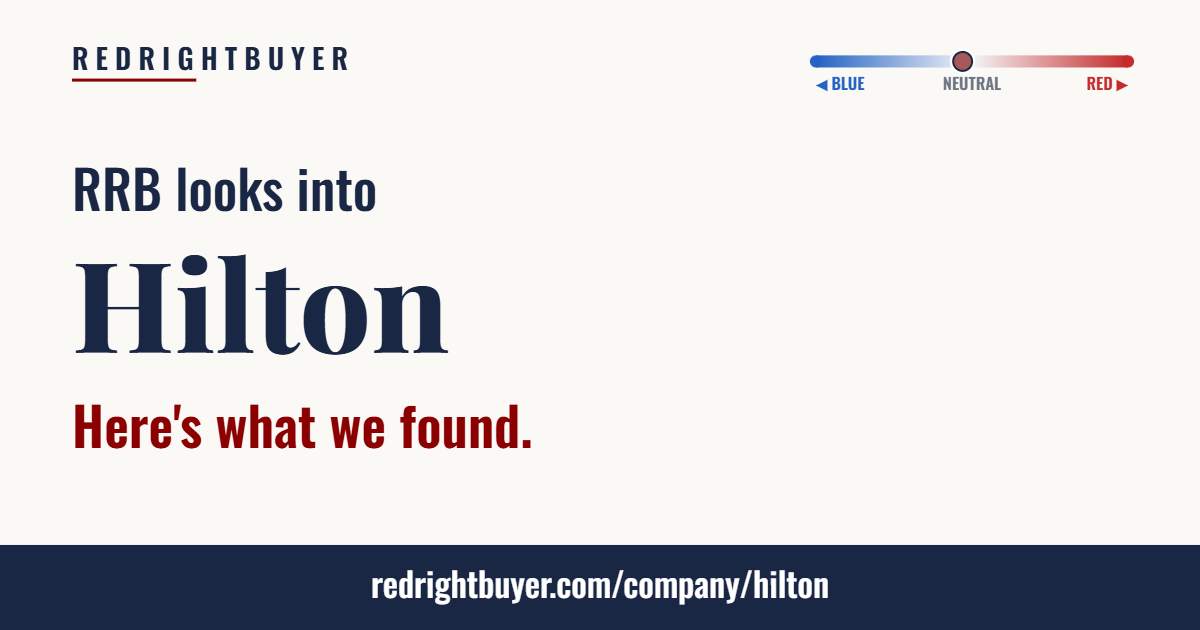
Hilton presents a study in corporate political balance. Its PAC divides federal candidate money almost evenly between the parties, its disclosure policy explicitly disclaims partisanship in favor of business interest, its CEO speaks up only on social questions tied directly to the hospitality business, and its lobbying tracks the practical concerns of the hotel industry rather than any ideological agenda. Set against that even-handed corporate posture is the unmistakably Republican history of the founding family, a legacy that colors the brand without steering the boardroom. For a company that hosts travelers of every political stripe, that careful balance reads less like indecision and more like strategy.
[1] Hilton corporate profile and brand portfolio, hilton.com and Hilton Worldwide Holdings investor disclosures. [2] Hilton Worldwide Political Action Committee committee overview, FEC.gov (committee ID C00213074, registered January 15, 1987). [3] Hilton Worldwide PAC contributions to federal candidates, 2024 cycle, OpenSecrets (candidate recipients; $51,000 total, $27,000 to Democrats / $24,000 to Republicans; House and Senate chamber splits and named recipients). [4] Hilton U.S. Political Contributions and Disclosure Policy, Hilton Investor Relations (ir.hilton.com governance documents). [5] Hilton Worldwide lobbying total for 2024, OpenSecrets organization profile (approximately $1.05 million). [6] Lodging/Tourism industry lobbying total for 2024, OpenSecrets industry profile (approximately $17.7 million). [7] Christopher J. Nassetta biography; Blackstone Group $26 billion buyout of Hilton, 2007. [8] Open letter from corporate executives opposing North Carolina House Bill 2, 2016. [9] Christopher Nassetta remarks on diversity as a "business imperative," ALIS hotel conference, January 2025 (Skift). [10] Christopher Nassetta interview on workplace culture and identity politics, Fortune, May 2024. [11] Conrad Hilton biography and service in the first New Mexico Legislature, 1912-1916. [13] Conrad N. Hilton Foundation history and mission; Conrad Hilton as an early supporter and benefactor of the National Prayer Breakfast (founder credit attributed to Abraham Vereide). [14] Hilton Worldwide Holdings Inc., NYSE: HLT, SEC EDGAR filings (CIK 0001585689). [15] American Hotel and Lodging Association membership and scale (represents major chains, roughly 80% of franchised hotels, and the largest U.S. hotel companies), AHLA and industry profiles. [16] AHLA advocacy priorities and HotelPAC (bipartisan PAC; H-2B and J-1 guest-worker visa expansion, opposition to joint-employer and overtime rules, hotel fee-disclosure fights, tourism-promotion funding), AHLA Advocacy materials and lobbying-disclosure reporting. [17] Hilton asset-light business model (approximately 90% of properties franchised or managed; franchise and management fees as the primary earnings driver), Hilton 10-K business description and investor reporting.
Comments
(0)No comments yet. Be the first to comment.