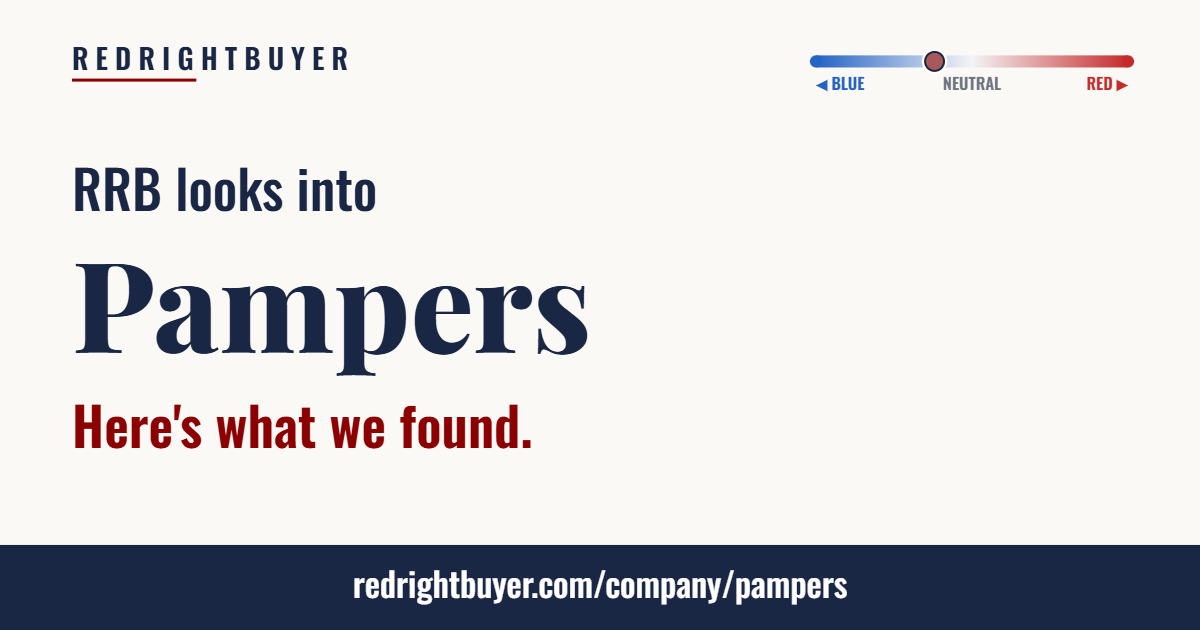

Pampers is the diaper bag staple in millions of American homes, a brand so woven into early parenthood that most shoppers never think to ask where it sits politically. The answer does not live with Pampers itself, which is a product line rather than an independent company, but with its owner: The Procter & Gamble Company, the Cincinnati consumer-goods giant founded in 1837 and traded on the New York Stock Exchange under the ticker PG. P&G owns a stable of household names, Tide, Charmin, Gillette, Crest, Always, Tampax, and Pampers among them, and any political signal attached to Pampers is really a signal about P&G. For a curious parent, the interesting part is that this maker of baby wipes and diapers turns out to be one of corporate America's more outspoken voices on cultural issues.
- Pampers is not a company but a brand inside Procter & Gamble, the $84 billion consumer-goods giant.
- P&G's employee-funded PAC says it aims for balanced giving, but 2024 dollars leaned Democratic.
- The company bans corporate money for federal candidates and super PACs, a deliberately restrained policy.
- P&G partners with GLAAD and has run LGBTQ-inclusive campaigns across its household brands.
- Conservative activists have repeatedly targeted P&G over DEI, and the company has defended it.
A Brand Inside a Corporate Giant
Pampers does not file its own political disclosures, run its own PAC, or take its own corporate positions. It is one brand within P&G's Baby, Feminine and Family Care segment. That means understanding Pampers politically requires looking at P&G as a whole: its corporate political action committee, its lobbying, and the public stances its leadership and marketing take. P&G is enormous, generating roughly $85 billion in annual sales and operating in around 70 countries, so its political activity is correspondingly substantial and, unusually for a consumer brand, fairly transparent.
The Corporate PAC Leans Modestly Democratic
P&G operates a federal political action committee called the Good Government Fund, funded by voluntary employee contributions rather than corporate money. In the 2024 election cycle, that PAC gave $249,500 directly to federal candidates, and the partisan split tilted modestly toward Democrats: roughly 57 percent of candidate dollars went to Democrats and 43 percent to Republicans, according to OpenSecrets. [1] Across all contributions in the cycle the organization's total reached about $599,595, split roughly 62 percent to Democrats and 38 percent to Republicans, and it reported no outside or super PAC spending at all. [2] A modest Democratic lean in direct candidate giving is a real, if not dramatic, signal, and it runs against the assumption some shoppers might make about a heartland Ohio manufacturer.
A Deliberately Restrained Spending Policy
P&G is notably explicit about what it will not do with corporate money. The company states that it does not use corporate funds to support super PACs, 527 organizations, or candidates, and that since 2012 it has instructed its trade associations that its dues may not be used for electioneering or independent political expenditures. [3] On lobbying, P&G reported $2.9 million in U.S. federal lobbying for calendar year 2024, plus $1.25 million in U.S. state lobbying and additional European Union lobbying, the ordinary business-issue advocacy of a large multinational on matters like tax and trade. [4] This combination, real lobbying spend but a self-imposed ban on the most aggressive forms of election spending, paints a company that engages politically through conventional, disclosed channels rather than through dark money.
Where the Stronger Signal Lives: LGBTQ-Inclusive Marketing
The clearest political signal in P&G's record is cultural rather than financial. The company has been one of the most prominent corporate champions of LGBTQ-inclusive advertising in the United States. P&G partnered with the LGBTQ media advocacy organization GLAAD on research promoting inclusive representation in advertising, and its Chief Brand Officer, Marc Pritchard, has publicly framed inclusive marketing as a way to "drive acceptance, inclusion and love for humanity." [5] P&G has run the recurring "Can't Cancel Pride" benefit supporting LGBTQ organizations, a program the Pampers brand itself has participated in alongside other P&G names. [6] The company has also publicly tied its brands, Pampers included, to diversity, equity and inclusion initiatives and to celebrating diverse family and cultural identities in its baby-name content. For readers, this sustained, named advocacy is the most concrete indicator of where the corporate culture sits.
Conservative Pushback
P&G's positioning has drawn direct fire from the political right, which offers a clearer read on where the company sits than its giving alone. In 2012, P&G ended its membership in the American Legislative Exchange Council (ALEC), the conservative state-policy network, amid a pressure campaign led by the progressive group Color of Change; conservative organizations characterized the move as siding with the left. [7] More recently, at P&G's October 2023 annual meeting, the conservative National Center for Public Policy Research put forward a shareholder proposal demanding an audit of whether the company's diversity, equity, and inclusion policies discriminate against non-minority employees, framed as a "reverse discrimination" review. P&G's board urged shareholders to reject it, and they did. [8] Both episodes show a company whose diversity and inclusion commitments have made it a repeated target for conservative activists, and whose leadership has consistently defended those commitments.
Conduct and Context
Like any company of its scale, P&G has drawn criticism from multiple directions, conservative commentators have at times objected to its inclusive marketing, while some LGBTQ advocates in earlier years argued the company did not go far enough in opposing discriminatory legislation. Worth flagging for accuracy: a widely circulated claim that Pampers faced backlash over a "trans baby" ad campaign traces to an openly satirical website and describes a fictional future event; it is not a real episode and is not treated as a signal here. The durable, verifiable picture is of a brand inside a company that leans gently Democratic in its candidate giving and leans more clearly progressive in its cultural marketing.
What It Adds Up To
For a parent trying to read Pampers politically, the honest summary is that the brand carries the politics of its parent, P&G, and those politics point in a consistent direction. The corporate PAC favors Democrats by a modest margin, the company restricts itself from the most aggressive election spending, and its public marketing posture, built around LGBTQ inclusion and diversity, is among the more progressive in mainstream consumer goods. None of this is hidden; P&G discloses its political involvement in detail and markets its values openly. The result is that one of the most ubiquitous baby products in America belongs to a company whose cultural signaling leans left of where many shoppers would guess.
[1] OpenSecrets, Procter & Gamble PAC candidate recipients, 2024 cycle (Democrats 57.18% / Republicans 42.82% of candidate contributions; $249,500 to federal candidates). https://www.opensecrets.org/political-action-committees-pacs/C00257329/candidate-recipients/2024
[2] OpenSecrets, Procter & Gamble organization summary, 2024 cycle ($599,595 total contributions; $0 outside spending). https://www.opensecrets.org/orgs/procter-gamble/summary?id=D000000485
[3] Procter & Gamble, "Our Political Involvement" (policy against corporate funds for super PACs, 527s, candidates; trade-association dues restriction since 2012). https://us.pg.com/structure-and-governance/our-political-involvement/
[4] Procter & Gamble, "Our Political Involvement," and OpenSecrets lobbying data (~$2.79 million federal lobbying, 2024). https://us.pg.com/structure-and-governance/our-political-involvement/
[5] Procter & Gamble, "P&G and GLAAD's New Study Reveals the Power of LGBTQ+ Inclusion in Advertising," quoting Chief Brand Officer Marc Pritchard. https://us.pg.com/blogs/power-of-lgbtq-inclusion-in-advertising/
[6] Procter & Gamble Citizenship Report 2022, Equality & Inclusion (Pampers participation; "Can't Cancel Pride" benefit). https://us.pg.com/citizenship-report-2022/equality-and-inclusion/
[7] Procter & Gamble ended its ALEC membership in 2012 amid a Color of Change pressure campaign; the conservative National Center for Public Policy Research framed it as siding with the left. National Center for Public Policy Research. https://nationalcenter.org/ncppr/2012/04/25/procter-gamble-sides-with-ultra-left-joins-anti-conservative-alec-boycott/ [8] National Center for Public Policy Research 2023 shareholder proposal requesting an audit of the impact of P&G's DEI policies on non-BIPOC communities, opposed by the P&G board and voted down at the October 10, 2023 annual meeting. SEC filing (P&G Form PX14A6G, 2023). https://www.sec.gov/Archives/edgar/data/0000080424/000109690623001921/bowy_px14a6g.htm
Comments
(0)No comments yet. Be the first to comment.