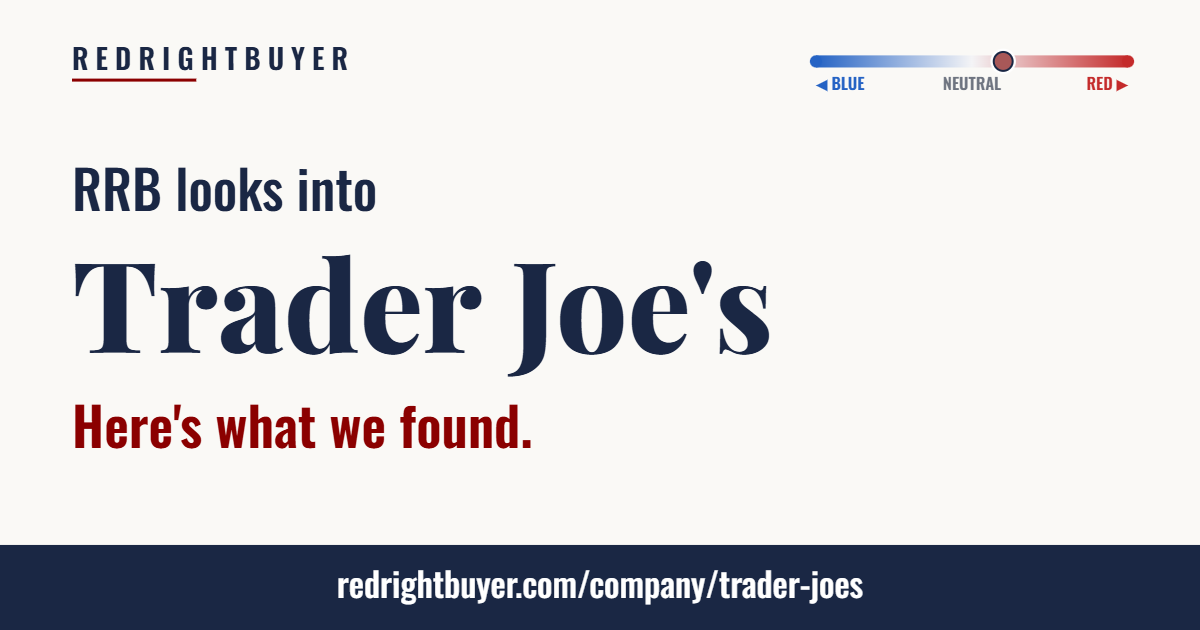

Trader Joe's is a privately held specialty grocery chain operating more than 570 stores across most US states, owned by the Aldi Nord branch of the German Albrecht family through a US holding company. The chain is known for its private-label products, distinctive store atmosphere, and notably tight-lipped corporate culture. The company rarely engages with media, makes minimal public political statements, and operates without a formal investor relations function. Trader Joe's became an active subject of political and labor-policy debate in 2024 when it joined a coordinated legal effort to challenge the constitutionality of the National Labor Relations Board, the federal agency that oversees union elections and labor-rights enforcement in the United States.
- In January 2024, Trader Joe's joined SpaceX, Amazon, and Starbucks in formally arguing before the NLRB that the agency itself is unconstitutional.
- The position is widely associated with the conservative movement to roll back New Deal-era federal labor protections.
- Trader Joe's faces multiple NLRB complaints alleging illegal union-busting activity at unionizing stores, including the alleged unlawful firing of a union supporter.
- The company is represented in its NLRB challenge by Morgan Lewis, the same firm representing Elon Musk's SpaceX in a parallel lawsuit.
Quick Take
In a January 16, 2024 hearing before the National Labor Relations Board, Trader Joe's joined Elon Musk's SpaceX, Amazon, and Starbucks in formally arguing that the NLRB itself is unconstitutional, a position widely associated with the conservative legal movement to roll back New Deal-era federal labor protections. The constitutional challenge came amid a wave of unionization efforts at Trader Joe's stores from 2022 through 2024 and against the backdrop of multiple NLRB complaints alleging that the company had engaged in illegal union-busting at the stores attempting to organize, including the alleged unlawful firing of a union supporter. Trader Joe's is represented in its NLRB challenge by the law firm Morgan Lewis, the same firm representing SpaceX in a parallel lawsuit, with senior labor attorneys including former Republican appointees to the NLRB itself. As a privately held foreign-owned company, Trader Joe's has no federal political action committee, no disclosed corporate political contributions, and no federal lobbying registration; the political signal for this rating lives in the company's labor-policy posture rather than in conventional corporate political activity.
Public Political Activity
Trader Joe's is owned by the Aldi Nord branch of the Albrecht family of Germany, and as a privately held foreign-owned company, it operates with no federal political action committee and no disclosed federal lobbying registration. Searches of OpenSecrets and the Federal Election Commission database return no Trader Joe's-affiliated PAC or material corporate political contributions in any recent cycle.[1] This is consistent with the company's broader media posture, which is unusually low-profile for a grocery chain of its size. Trader Joe's does not maintain an investor relations function, does not issue regular corporate press releases, and rarely makes its executives available for press interviews.
The political signal for Trader Joe's therefore lives almost entirely in its labor-policy posture, particularly its formal legal challenge to the constitutional authority of the National Labor Relations Board.
Public Positions and Statements
The NLRB Constitutionality Challenge
In a January 16, 2024 hearing before the NLRB Region 1 office in Connecticut, Trader Joe's attorney Christopher Murphy of the law firm Morgan Lewis introduced what he called "one final thing" the grocery chain wanted to add to its defense before the proceeding began: that "the National Labor Relations Act as interpreted and/or applied in this matter, including but not limited to the structure and organization of the National Labor Relations Board and the agency's administrative law judges, is unconstitutional."[2] Administrative Law Judge Charles Muhl, presiding over the hearing, responded that he was "certainly not going to be ruling on my own constitutionality anytime soon" and indicated that the matter would have to be addressed by NLRB members or federal courts on appeal.
The argument joined a broader, coordinated legal challenge being advanced by SpaceX, Amazon, and Starbucks, all of which pursued similar constitutional challenges in the same period.[3] The legal theory rests on three claims: that NLRB members and administrative law judges are improperly insulated from presidential removal authority in violation of separation-of-powers principles; that NLRB administrative proceedings violate the Seventh Amendment right to a jury trial in civil cases; and that the agency's combination of investigative, prosecutorial, and adjudicative functions improperly concentrates governmental power. The argument is associated with the conservative legal movement and parallels reasoning that the Supreme Court has accepted in related cases involving other federal regulatory agencies, including SEC v. Jarkesy.
Trader Joe's is represented in this challenge by the law firm Morgan Lewis, the same firm representing Elon Musk's SpaceX in a parallel federal lawsuit pursuing the same constitutional theory.[3] Morgan Lewis's labor and employment practice includes attorneys who previously served as Republican appointees to the NLRB itself.
The company has not publicly characterized this legal position as politically motivated and has framed it as a defensive constitutional argument in the specific NLRB case against Trader Joe's. Whether the legal position itself is "political" is disputed: Trader Joe's and its attorneys describe it as a defensive constitutional argument; labor advocates and many legal scholars describe it as an ideologically-aligned attempt to disable a federal agency that has been understood as constitutionally legitimate since the Supreme Court upheld the NLRB's structure in 1937.
Underlying NLRB Complaints
The constitutional challenge came against the backdrop of a series of unionization efforts at Trader Joe's stores beginning in July 2022, when workers at a Hadley, Massachusetts location voted to form the company's first union under the Trader Joe's United banner. Additional unionization votes followed in Minneapolis, Louisville, and Oakland through 2023 and 2024. Multiple NLRB complaints were filed alleging that Trader Joe's engaged in illegal union-busting activity at these and other stores. The specific allegations reported in NLRB filings and in subsequent journalism include the alleged unlawful firing of a union supporter, alleged withholding of retirement-plan contributions and other benefits from unionized stores, alleged "captive audience" anti-union meetings in which workers were required to attend management presentations opposing unionization, and alleged interrogation of workers about union activity.[2] Trader Joe's has denied these allegations.
Other Public Positioning
Outside of the NLRB matter, Trader Joe's has maintained a comparatively quiet public posture on political and social issues. The company does not publish DEI commitments comparable to those of larger competitors, does not issue corporate statements on contested political issues, and has not been a meaningful donor to any political candidate or committee. The company's public-facing brand identity emphasizes its product offering, store atmosphere, and customer experience rather than corporate political values.
Products and Customer Base
Trader Joe's operates more than 570 stores across most US states, with the largest concentrations in California, the Northeast corridor, and major metropolitan areas. The chain is known for an unusual product strategy that emphasizes private-label products sold under the Trader Joe's brand or sub-brands like Trader Ming's, Trader Giotto's, and Trader José's, with a tight assortment of roughly 4,000 products per store compared to 30,000 or more at conventional grocers, and frequent product turnover. Stores typically feature smaller footprints (around 12,000 to 15,000 square feet) and a distinctive customer experience emphasizing in-store sampling, hand-drawn signage, and Hawaiian-shirt-clad staff.
Customers are typically value-conscious shoppers in middle and upper-middle income brackets, with the chain widely associated with college towns, urban neighborhoods, and suburban areas with educated professional demographics. Trader Joe's does not operate an e-commerce business of any kind and does not currently offer delivery, online ordering, or third-party-platform partnerships.
Founding and Ownership
Trader Joe's was founded in 1958 by Joe Coulombe in Pasadena, California, originally as a chain of convenience stores called Pronto Markets. Coulombe converted the chain to its current grocery format in 1967 and renamed it Trader Joe's, drawing inspiration from Adventureland tropical themes. In 1979, Coulombe sold the company to Theo Albrecht, founder of Aldi Nord, the German discount grocery chain. Trader Joe's has remained under Aldi Nord ownership through a US holding company in the decades since, while operating as a fully independent brand with no Aldi-branded product crossover.
The Albrecht family owns one of the largest privately held fortunes in Europe, with Aldi Nord and the separately-managed Aldi Süd (which owns the US Aldi chain) together operating the largest grocery store network in Germany and substantial retail operations across Europe and beyond. Both branches of Aldi maintain a deliberately low public profile.
Day-to-day operations are run from the company's corporate headquarters in Monrovia, California.
Where to Find Them
Trader Joe's stores are located across most US states; a complete store locator is available at traderjoes.com. The company does not operate any e-commerce, delivery, or third-party-platform partnerships, so all customer purchases happen in physical stores.
Footnotes
[1] OpenSecrets.org and Federal Election Commission, search results for Trader Joe's-affiliated PACs and lobbying registrations, accessed May 6, 2026. https://www.opensecrets.org/ ; https://www.fec.gov/
[2] Dave Jamieson, HuffPost, "Trader Joe's Argues The NLRB Is 'Unconstitutional,'" January 26, 2024. https://www.huffpost.com/entry/trader-joes-attorney-nlrb-unconstitutional_n_65b41e7ae4b014b873b11cc2
[3] Josh Eidelson, Fortune, "Elon Musk and SpaceX are right about the National Labor Relations Board being unconstitutional, argues Trader Joe's," January 27, 2024. https://fortune.com/2024/01/27/elon-musk-spacex-right-nlrb-unconstitutional-says-trader-joes/
[4] OnLabor, "News & Commentary: January 28, 2024," January 28, 2024. https://onlabor.org/january-28-2024/
[5] Fortune, "Amazon joins Trader Joe's and Elon Musk's SpaceX in calling the National Labor Relations Board unconstitutional," February 17, 2024. https://fortune.com/2024/02/17/amazon-spacex-trader-joes-nlrb-unconstitutional/
Comments
(0)No comments yet. Be the first to comment.